


How to Use Dog Treats for Positive Reinforcement Training

How to Use Dog Treats for Positive Reinforcement Training
Knowing how to use dog treats for positive reinforcement is the difference between treats that build lasting behavior and treats that just make your dog follow your hand around hoping something falls out.
My wife and I are not professional trainers.
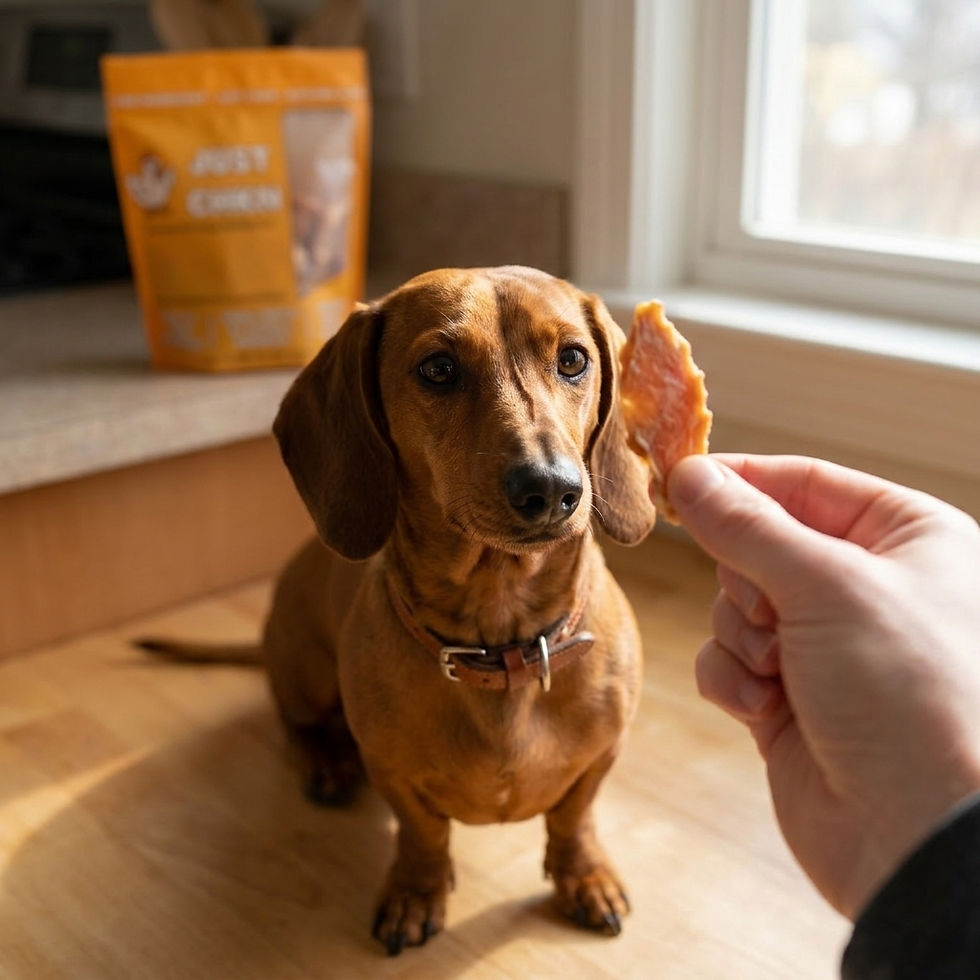
What we are is two people who trained Alfredo, our younger dachshund, almost entirely using JUST CHKN treats, and watched him go from a skeptical, easily distracted puppy to a dog who responds reliably to commands in real environments.
The treat was not magic.
The way we used it was what mattered.
The Core Principle: Timing Is Everything
In positive reinforcement training, the treat marks the exact moment the correct behavior happened.
A treat delivered three seconds after a sit is not reinforcing the sit.
It is reinforcing whatever the dog was doing three seconds after the sit, which might be sniffing the floor, looking away, or starting to stand back up.
This sounds simple and it is genuinely hard to do consistently at first.
The treat needs to arrive within one to two seconds of the behavior.
If your timing is off, the association does not form cleanly, and you end up with a dog who sits and then immediately starts scanning for the treat rather than holding the position.
The workaround most trainers recommend is a marker, either a clicker or a verbal cue like "yes," delivered the instant the behavior happens, followed immediately by the treat.
The marker bridges the gap between the moment of the behavior and the physical delivery of the reward.
Alfredo learned this pattern quickly once we were consistent about it.
The marker hit at the right moment and the treat followed, and within a few sessions he was offering behaviors deliberately to earn the reward rather than waiting to be lured.
Positive Reinforcement Dog Training With Treats: What to Use
The treat you choose affects how hard your dog works and how quickly they learn.
A low-value treat in a low-distraction environment will often be enough for basic behavior development at home.
The same treat at the dog park, surrounded by other dogs and interesting smells, may not compete effectively with the environment.
High-value treats are real meat options that dogs find genuinely compelling regardless of what else is happening around them.
Single-ingredient dehydrated chicken jerky sits at the top of this category for most dogs, because the concentrated real-meat smell cuts through distractions in a way that biscuits and commercial soft chews typically cannot.
We designed JUST CHKN to work exactly this way: high enough value to motivate reliably, lean enough in fat and calories to use in volume without concern, and easy to break into small pieces for rapid reward delivery.

How Often to Reward a Dog With Treats During Training
This depends entirely on where you are in the training process.
When a dog is learning a new behavior for the first time, reward every single correct repetition.
Every sit.
Every stay.
Every recall.
Consistent reinforcement in the early learning phase builds the association fast.
Once the behavior is established and reliable in low-distraction environments, you can begin what trainers call a variable reinforcement schedule, rewarding some repetitions but not all.
Variable reinforcement actually produces more persistent behavior than continuous reinforcement, which is why it is the standard approach for maintaining trained behaviors over time.
The dog learns that a reward might come on any given repetition, which keeps them engaged and offering the behavior rather than stopping when the treat flow slows down.
For Alfredo, we moved to variable reinforcement on his basic commands after about three weeks of consistent daily training sessions.
He has retained those behaviors reliably since.
When to Give Treats During Dog Training: Luring vs. Rewarding
There is an important distinction between using a treat to lure a behavior (holding it to guide the dog into position) and using a treat to reward a behavior after it happens.
Luring is a useful starting tool.
A treat held at nose height and moved slowly backward will get most dogs into a sit without any verbal instruction.
But luring can become a crutch if you do not phase it out quickly.
A dog trained entirely on luring learns to follow food, not to respond to a cue.
The goal is to get the behavior happening reliably on lure, then immediately begin asking for the behavior without the lure visible, and marking and rewarding when it happens anyway.
Most dogs make this transition within a handful of sessions if the reinforcement history is strong enough.
Fading Treats in Dog Training
The long-term goal is a dog who performs reliably even when treats are not present.
Fading treats does not mean stopping rewards.
It means transitioning from food rewards to a combination of occasional food rewards, praise, play, and life rewards (things the dog wants, like going outside or getting their leash put on) as reinforcers.
If your dog currently will not perform a behavior without a treat visible, that is a sign the treat has been used as a lure rather than a reward, and the behavior was never fully trained off the lure.
The fix is to go back to basics, build the behavior on a clear cue without food visible, and then build a strong reinforcement history on that cue before fading the treat frequency.
For more on choosing the right treat to make this whole process work, our post on what makes a dog treat actually healthy covers the ingredient side of the equation.


Comments